Russia Feed Market Outlook 2026–2030: Trends, Opportunities, and the Future of Animal Nutrition
Russia Feed Market Outlook 2026–2030
Russia has established itself as one of the world's major agricultural and livestock producers. Supported by abundant grain resources, large-scale farming operations, and increasing investment in food security, the country's feed industry has become one of the largest in Europe and Eurasia.
Today, Russia produces tens of millions of tons of compound feed annually, supplying poultry, swine, dairy, beef, aquaculture, and pet food industries. However, the period from 2026 to 2030 is expected to mark a transition from expansion-driven growth to efficiency-driven growth.
Future competitiveness will depend less on producing more feed and more on producing better feed—feed that improves animal performance, reduces production costs, and enhances profitability throughout the livestock value chain.
The third force is raw material economics. Russia's strong grain and oilseed base is a competitive advantage, but export policy, regional logistics, crop quality and oilseed crushing margins will continue to affect feed cost. Feed mills that can reformulate quickly and test raw materials accurately will be more resilient.
Five major forces are expected to shape Russia's feed industry over the next five years:
✔ Livestock integration
✔ Feed additive localization
✔ Raw material economics
✔ Specialized feed development
✔ Feed mill modernization
Together, these trends will redefine investment priorities, technology adoption, and market opportunities across the Russian animal nutrition sector.
Overview of Russia's Feed Industry
Russia's feed sector is heavily influenced by vertically integrated agricultural groups that manage grain production, feed manufacturing, livestock farming, meat processing, and distribution.
The largest feed-consuming sectors include:
Feed Segment
Market Position
Poultry Feed
Largest
Swine Feed
Second Largest
Dairy Feed
Growing
Beef Feed
Stable
Aquafeed
Fast Growing
Pet Food
High-Value Segment
Large agricultural holdings increasingly prefer controlling feed production internally because feed costs often account for 60–70% of total livestock production expenses.
Although Russia's feed industry is already mature, growth is expected to remain steady through ongoing livestock modernization and increasing demand for higher-quality nutrition.
Unlike emerging markets where growth is driven primarily by volume, Russia's future growth will be driven by:
✔ Improved feed conversion efficiency
✔ Better livestock performance
✔ Precision nutrition
✔ Automation and digitalization
✔ Enhanced quality control
Market Development Roadmap
Year
Key Industry Trend
2026
Expansion of domestic feed additive production
2027
Increased investment in automated feed mills
2028
Rapid growth of aquafeed and pet food sectors
2029
Digital feed mill management becomes mainstream
2030
Smart feed manufacturing systems dominate new projects
The next generation of feed plants will focus on reducing production costs while maximizing animal performance and feed utilization.
Key Trends Shaping Russia's Feed Market
1. Livestock Integration Will Continue to Expand
One of the most important trends in Russia's feed industry is the continued expansion of vertically integrated livestock operations.
Large poultry and swine producers increasingly operate their own feed mills to ensure:
✔ Stable feed supply
✔ Better quality control
✔ Lower production costs
✔ Improved biosecurity
As integration increases, equipment suppliers must demonstrate measurable improvements in:
✔ Feed Conversion Ratio (FCR)
✔ Daily weight gain
✔ Livestock health
✔Mortality reduction
✔ Pellet quality
✔ Production efficiency
Market access will increasingly depend on technical expertise rather than simply offering low-cost equipment.
2. Feed Additive Localization and Import Substitution
Russia continues to prioritize domestic production of strategic agricultural inputs.
Government-supported localization programs are encouraging investment in:
✔ Amino acids
✔ Vitamins
✔ Organic acids
✔ Feed enzymes
✔ Mineral premixes
✔ Functional feed additives
Significant progress has already been made in reducing dependence on imported amino acids.
However, opportunities remain in specialized areas such as:
✔ Advanced enzymes
✔ Specialty amino acids
✔ Precision nutrition additives
✔ Aquaculture nutrition ingredients
✔ High-performance vitamin products
This creates opportunities for international technology providers capable of supporting local production and quality benchmarking.
3. Raw Material Economics Will Drive Profitability
Russia possesses one of the world's strongest grain and oilseed production bases.
Major feed ingredients include:
✔ Wheat
✔ Corn
✔ Barley
✔ Soybean meal
✔ Sunflower meal
✔ Rapeseed meal
This provides a significant competitive advantage for feed manufacturers.
However, profitability remains highly sensitive to:
✔ Export regulations
✔ Regional logistics costs
✔ Crop quality variations
✔ Currency fluctuations
✔ Oilseed crushing margins
Future feed mills must become increasingly flexible.
Key competitive advantages will include:
✔ Rapid feed reformulation
✔ Real-time ingredient analysis
✔ Advanced feed software
✔ Precision batching systems
The ability to optimize feed formulas quickly may become as important as access to raw materials themselves.
4. Specialized Feed Segments Will Grow Faster Than Traditional Feed
Although poultry and swine feed will continue to dominate overall production, specialized feed sectors are expected to generate stronger profit margins.
Aquafeed
Russia's aquaculture sector is receiving increasing investment as the country seeks to improve domestic seafood production.
Key species include:
✔ Salmon
✔ Trout
✔ Carp
✔ Sturgeon
✔ Catfish
Modern aquafeed production requires:
✔ Twin-screw extruders
✔ Vacuum coating systems
✔ Oil spraying equipment
✔ Advanced drying systems
As fish farming expands, aquafeed is expected to become one of the fastest-growing feed categories.
Premium Pet Food
Russia's pet food market is rapidly evolving.
Consumers increasingly demand:
✔ Premium dog food
✔ Premium cat food
✔ Functional nutrition
✔ High-protein formulas
✔ Grain-free products
Domestic manufacturers continue to expand production capacity, creating demand for advanced pet food processing technology.
Young Animal Nutrition
Feed for piglets, chicks, and calves requires:
✔ Precise micro-dosing
✔ Specialized additives
✔ High mixing uniformity
✔ Strict quality control
These products typically command higher margins than standard compound feed.
Russia Aquafeed Market Analysis
Aquaculture is becoming a strategic priority for Russia's food industry.
Government support, increasing seafood consumption, and import substitution policies are driving investment in fish farming.
Aquafeed plants are likely to become one of the most attractive investment segments between 2026 and 2030.
Russia Pet Food Market Outlook
The pet food industry represents one of the fastest-growing high-value sectors in Russia's feed market.
Pet owners increasingly prioritize:
✔ Nutritional quality
✔ Functional ingredients
✔ Premium brands
✔ Specialized formulations
As domestic production expands, demand is rising for:
✔ Pet food extrusion systems
✔ Flavoring and coating equipment
✔ Drying and cooling technologies
✔ Automated packaging lines
Unlike commodity feed, pet food producers often prioritize product consistency and brand differentiation, making them attractive customers for advanced processing technologies.
5. Modern Feed Mills Will Focus on Automation and Quality Control
The modernization of Russian feed mills is accelerating.
Large feed manufacturers increasingly recognize that inconsistent feed quality directly impacts profitability.
Future feed plants will invest heavily in:
Automated Production Systems
✔ PLC control systems
✔ SCADA monitoring
✔ Intelligent batching systems
✔ Automated material handling
Precision Micro-Dosing
Accurate addition of:
✔ Vitamins
✔ Enzymes
✔ Amino acids
✔ Trace minerals
helps improve nutritional consistency and animal performance.
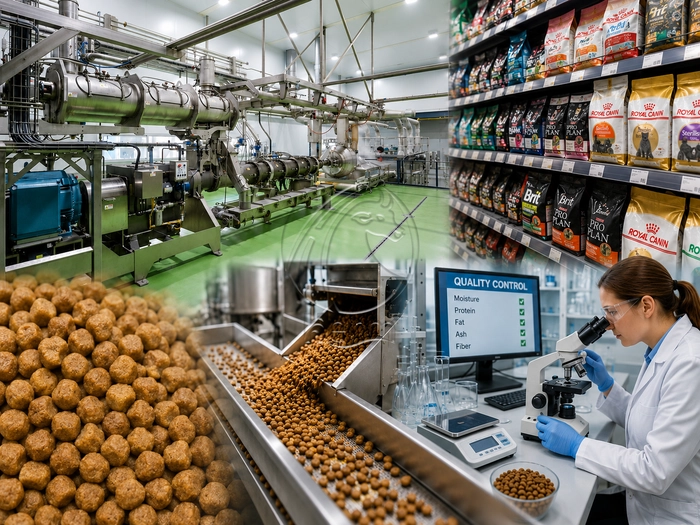
Laboratory Testing
Modern feed laboratories utilize:
✔ NIR analyzers
✔ Moisture testing equipment
✔ Protein analyzers
✔ Mycotoxin detection systems
Digital Traceability
Digital records enable complete monitoring of:
✔ Raw materials
✔ Production batches
✔ Feed formulas
✔ Quality parameters
✔ Finished products
Quality control is increasingly viewed as a profit center rather than simply a compliance requirement.
Top Feed Manufacturers in Russia
The Russian feed industry is dominated by several major agribusiness groups.
Key industry players include:
Company
Main Activities
Cherkizovo Group
Poultry, pork, feed production
Miratorg
Swine, beef, feed
Prioskolye
Poultry integration
Agro-Belogorie
Swine and feed
Rusagro
Feed, pork, oilseed processing
EkoNiva
Dairy production and feed demand
These companies represent the primary customers for advanced feed processing technologies and turnkey feed mill projects.
Feed Mill Investment Cost in Russia
Investment requirements vary significantly depending on project size and automation level.
Typical Feed Mill Investment Range
Project Type
Capacity
Estimated Investment
Small Feed Mill
1–5 T/H
USD 100,000–500,000
Medium Feed Mill
5–15 T/H
USD 500,000–2 Million
Large Feed Mill
15–40 T/H
USD 2–10 Million
Integrated Feed Complex
40 T/H+
USD 10 Million+
Investment categories typically include:
✔ Land and buildings
✔ Steel structures
✔ Feed processing equipment
✔ Storage silos
✔ Automation systems
✔ Electrical systems
✔ Laboratory equipment
✔ Installation and commissioning
Modern investors increasingly evaluate projects based on feed efficiency gains and operational performance rather than equipment price alone.
Opportunities for Chinese Feed Equipment Suppliers
Chinese feed machinery manufacturers have significantly improved technology, automation, and engineering capabilities in recent years.
For Russian investors, Chinese suppliers offer several advantages:
Competitive Advantages
✔ Competitive project costs
✔ Reliable equipment quality
✔ Faster delivery schedules
✔ Flexible customization
✔ Complete turnkey solutions
High-Demand Equipment Categories
✔ Hammer mills
✔ Feed mixers
✔ Pellet mills
✔ Counterflow coolers
✔ Crumblers
✔ Rotary sifters
✔ Automatic batching systems
✔ Premix production lines
✔ Aquafeed extrusion systems
✔ Pet food production lines
Suppliers capable of delivering complete engineering solutions are expected to gain a competitive edge.
Why Turnkey Feed Mill Solutions Are Becoming More Popular
As feed production becomes increasingly sophisticated, Russian investors prefer integrated solutions rather than purchasing individual machines from multiple suppliers.
Turnkey solutions help reduce project risks, shorten implementation time, and improve production efficiency.
Challenges Facing the Russian Feed Industry
Despite strong fundamentals, several challenges remain.
Economic Challenges
✔ Inflation
✔ Currency volatility
✔ Financing costs
Supply Chain Challenges
✔ International sanctions
✔ Logistics disruptions
✔ Payment restrictions
Livestock Industry Risks
✔ African Swine Fever (ASF)
✔ Avian Influenza
✔ Disease outbreaks
Regulatory Challenges
✔ Feed safety standards
✔ Import restrictions
✔ Certification requirements
Companies entering the market should carefully assess compliance requirements and work with experienced local partners.
Frequently Asked Questions (FAQ)
Is Russia a growing feed market?
Yes. Russia remains one of the largest feed-producing countries in Europe and Eurasia. Growth will be driven by modernization, efficiency improvements, aquaculture expansion, and premium nutrition products.
Which feed segment offers the greatest growth potential?
Aquafeed, premium pet food, and young animal nutrition are expected to achieve the fastest growth and highest profit margins.
What feed equipment is most in demand?
Pellet mills, automated batching systems, feed mixers, aquafeed extruders, pet food production lines, and quality-control equipment are among the most sought-after technologies.
Are turnkey feed mill projects popular in Russia?
Yes. Large livestock groups increasingly prefer turnkey projects that include engineering design, automation, installation, commissioning, and technical support.
Conclusion
Russia's feed market from 2026 to 2030 will be defined by efficiency, localization, specialization, and modernization rather than simple production growth.
The most successful feed producers will be those capable of:
✔ Improving feed conversion efficiency
✔ Optimizing raw material utilization
✔ Implementing precision nutrition
✔ Adopting automation technologies
✔ Maintaining consistent feed quality
For feed equipment manufacturers, feed additive suppliers, and engineering solution providers, Russia remains one of the largest and most technically demanding animal nutrition markets in Eurasia.
Companies that can deliver reliable technology, advanced automation, and complete turnkey feed mill solutions will be well-positioned to benefit from the next phase of Russia's feed industry development.
Contact us today for a customized poultry feed solution.
Henan Herm Machinery Co., Ltd was established in 2010 and has been devoted to the research and development of Feed Mill Machinery ever since. With more than 10 years of experience, Herm® has become a leading manufacturer and supplier of animal feed machines and complete animal feed production lines, cattle feed plants, poultry feed plants, animal feed pellet production lines, etc. It always endeavored to improve the quality of products and aims to meet the new requirements of the international market.
If You Are Ready to start a Feed Pellet Plant Business, please get in touch with us for the feed mill machine. We Can Provide Professional Design and Comprehensive Guidance According to Your Needs. Get in touch with us now!